Completing an advanced diagnostic imaging procedure is a significant step forward in your medical journey. When you step off the table after a PET Scan in Bangalore, you carry a tremendous sense of relief, knowing that your medical team is actively gathering the precise, microscopic data necessary to chart your treatment course.
However, while the scanning process itself is over, your interaction with the diagnostic protocol is not finished.
To create the high-resolution images that your oncologist or cardiologist relies on, a microscopic amount of a radioactive tracer such as FDG, PSMA, or DOTANOC was administered into your bloodstream. While this tracer is entirely safe and explicitly designed for rapid elimination, understanding the correct precautions after a PET scan procedure is vital.
The immediate hours following your appointment dictate how quickly this tracer is flushed from your system. By following a few simple, highly specific aftercare guidelines, you guarantee your own comfort, optimize your physical recovery, and ensure absolute safety for the friends and family members waiting for you at home.
In this clinical guide, we will break down exactly what you need to do and avoid in the critical 24 hours following your advanced nuclear imaging session.
Medical Disclaimer
The clinical advice, post-procedure timelines, and hygiene protocols outlined in this guide regarding after-scan precautions are intended strictly for educational and informational purposes. They do not substitute for a formal medical consultation, a personalized discharge plan, or a physician’s direct orders. Radiotracer elimination rates can vary based on individual renal function, metabolic health, and the specific type of isotope administered. Always consult directly with your radiologist, nuclear medicine technician, or referring specialist to interpret your specific post-scan instructions. Never disregard professional clinical guidance or delay seeking emergency medical attention if you experience severe adverse symptoms following an imaging procedure.
Hydration and Hygiene: The Critical First 24 Hours
The absolute cornerstone of After PET scan care is actively accelerating the body’s natural elimination of the radioactive isotope. As the tracers used in advanced nuclear imaging (such as FDG, PSMA, or DOTANOC) are water-soluble, they are almost entirely processed by your kidneys and expelled through your urinary tract.
While the radioactivity will naturally decay due to its exceptionally short half-life, you can take immediate physical control of this process through aggressive hydration and rigorous bathroom hygiene.
The Hydration Protocol: Flushing the Tracer

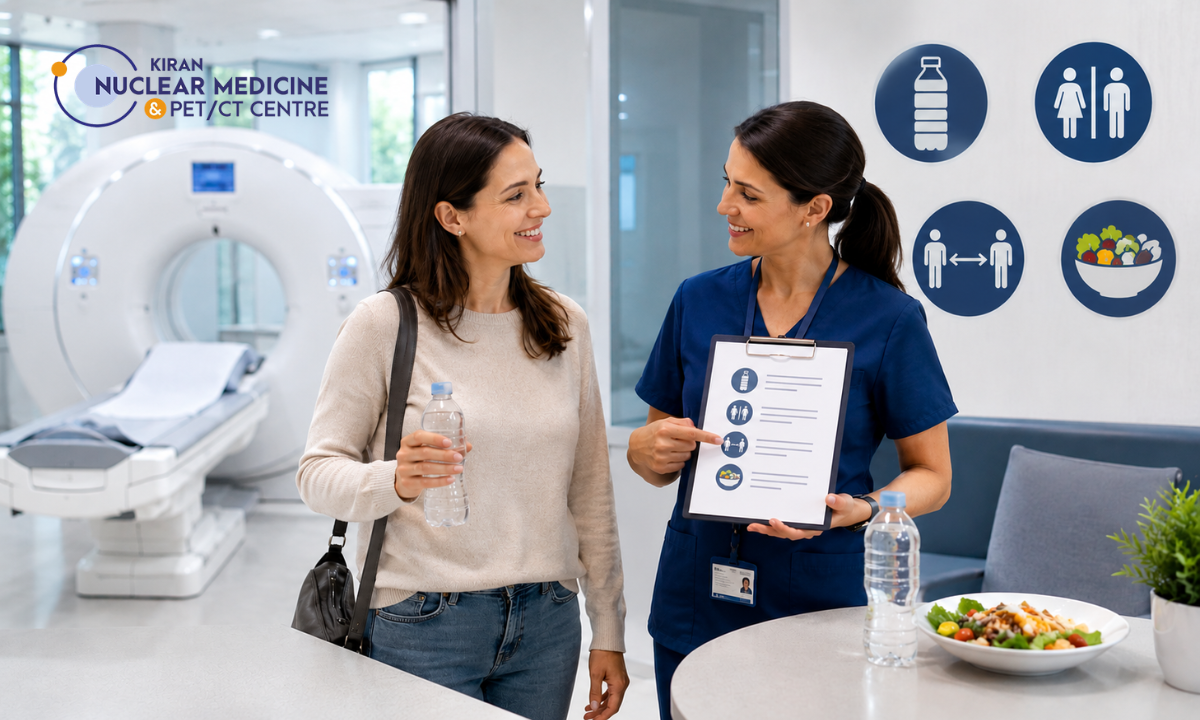
To ensure the radiotracer is cleared from your system as quickly as possible, oncologists and nuclear medicine specialists recommend a high-volume fluid intake immediately after the procedure.
- The Fluid Goal: You must consume 8 to 10 large glasses of water (approximately 1.5 to 2 liters) within the first 24 hours following your scan.
- Approved Beverages: Plain water is the optimal choice. Clear broths and electrolyte solutions (sports drinks) are also acceptable.
- What to Avoid: Strictly avoid high-caffeine beverages (like strong coffee or energy drinks) and alcohol for the first 24 hours. Caffeine acts as a diuretic that can lead to systemic dehydration, counteracting your effort to flush the kidneys effectively.
Clinical Indicator: A simple visual check is your best tool. Your urine should remain pale yellow or entirely clear. If it appears dark, you are not adequately hydrated and must increase your water intake.
Enhanced Bathroom Hygiene Practices
Because the radioactive tracer exits your body primarily through your urine, your bathroom routine requires a temporary, specialized protocol to prevent cross-contamination and protect household members.
| The Practice | The Clinical Protocol | The Scientific Rationale |
|---|---|---|
| Urination Posture | Both men and women must sit down on the toilet to urinate for the first 24 hours. | This eliminates the risk of microscopic radioactive splashes contaminating the toilet rim, floor, or surrounding bathroom surfaces. |
| The Double Flush | Always close the toilet lid, then flush the toilet twice after every single use. | Closing the lid prevents aerosolization (micro-droplets entering the air), while double flushing guarantees that the tracer is completely evacuated from the plumbing trap. |
| Hand Sanitation | Wash your hands vigorously with soap and warm water for at least 20 seconds. | Eliminates any potential microscopic transfer of the radiotracer from your hands to communal household surfaces like doorknobs or kitchen counters. |
| Separate Facilities | If your home has multiple bathrooms, designate one exclusively for your use. | This creates an isolated biological zone, completely removing the risk of accidental exposure to other family members. |
Strictly adhering to these hydration and hygiene guidelines, you effectively neutralize any secondary radiation risks within the very first day of your recovery, allowing the tracer to leave your body safely and efficiently.
Managing Social Contact: Protecting Your Loved Ones
The most common question patients ask regarding PET scan safety is: Will I expose my family to radiation when I go home?
It is completely normal to feel anxious about this, but understanding the physics of the radiotracer removes the fear. The tracers used at specialized centers like Kiran PET CT have a very short half-life (usually around 110 minutes for standard FDG tracers).
This means the radioactivity rapidly decays and halves its strength roughly every two hours, in addition to being actively flushed out by your kidneys.
However, because vulnerable biological systems are highly sensitive to even trace amounts of radiation, international medical boards mandate a strict distance and time protocol for the first 12 to 24 hours.
The Distance and Time Safety Protocol
To ensure absolute safety for your household, adhere to the following isolation matrix as soon as you leave the diagnostic center:
| The Vulnerable Group | The Safe Distance Rule | Required Duration |
|---|---|---|
| Pregnant Women | Maintain a strict distance of at least 2 meters (6 feet). Avoid sharing a vehicle or sitting in the same room. | 24 Hours |
| Infants & Young Children | Avoid all close physical contact. No hugging, holding on laps, or sharing a bed. | 12 to 24 Hours |
| Healthy Adults | Limit prolonged proximity. Avoid hugging or kissing. | 6 Hours |
| Household Pets | Limit prolonged physical contact, as pets often sleep closely against the body. | 6 to 12 Hours |
Bedroom Safety Guidelines
Because we spend prolonged periods in proximity to others while sleeping, your sleeping arrangements require a slight modification for the first night following your scan.
- Separate Sleeping Quarters: It is highly recommended that you sleep in a separate bedroom for the first night.
- The 3-Foot Rule: If moving to a separate room is absolutely not possible, ensure there is at least a 3-foot physical distance between you and your bed partner.
The Reassuring Fact: These guidelines are extremely cautious by design. The radiation emitted by your body drops to near-zero levels very quickly. By simply maintaining a short-term physical distance, you are acting as a highly responsible patient without needing to fear the medical process.
What is Normal?
It is entirely natural to wonder if you will physically feel different after the procedure. One of the most significant benefits of advanced nuclear imaging is that the PET scan side effects are incredibly rare, and when they do occur, they are remarkably mild and short-lived.
Unlike the powerful medications used in therapeutic treatments (like chemotherapy), the radiotracer used during your scan is purely a diagnostic agent. It has no pharmacological effect on your body’s actual tissues. However, you might experience a few transient, normal sensations as your body processes the injection.
Common and Harmless After-Effects
If you experience any of the following within the first 12 to 24 hours, there is no need for a clinical alarm:
- Mild Fatigue: Feeling unusually tired is the most common sensation reported by patients. This is rarely caused by the radiotracer itself. Instead, it is usually the physical result of the mandatory fasting before the scan, combined with the emotional stress of undergoing a major medical evaluation.
- Injection Site Sensitivity: You may notice slight redness, a tiny bruise, or minor soreness exactly where the intravenous (IV) needle was placed. This is a standard reaction to any needle puncture and typically resolves within a day.
- Transient Metallic Taste: A small percentage of patients report a fleeting metallic taste in their mouth as the tracer initially circulates through the bloodstream. This is harmless and usually dissipates very quickly.
- Frequent Urination: Because you are aggressively hydrating to flush the tracer out, you will experience an increased need to use the restroom. This is not a side effect, but rather the desired result of your aftercare protocol!
When to Contact Your Doctor: While severe reactions to diagnostic tracers (like FDG or PSMA) are exceptionally rare, you should always monitor your body.
On the very slim chance that you experience symptoms of an allergic reaction, such as developing widespread hives, experiencing sudden shortness of breath, or feeling intense dizziness, you must contact your healthcare provider or seek emergency medical attention immediately.
Resuming Daily Life: Diet, Activity, and Special Cases
After you have safely navigated the first few hours of your PET scan recovery, transitioning back to your normal routine is remarkably straightforward. Because diagnostic tracers do not chemically alter your cells or cause systemic physical exhaustion, the restrictions on your daily life are incredibly minimal.
Diet and Physical Activity

Unless your oncologist or referring physician has given you specific contraindications based on your underlying health condition, your routine can resume almost immediately:
- Dietary Freedom: You can return to your normal diet as soon as you leave the clinic. In fact, eating a balanced meal can help restore your energy levels if you feel fatigued from pre-scan fasting.
- Medications: You can immediately resume taking your daily prescription medications, including diabetic control medications that you may have been asked to pause on the morning of the scan.
- Physical Activity: Light to moderate activity is perfectly fine. However, because you are actively flushing your system, you should avoid intense, exhausting workouts for the first 24 hours to prevent dehydration through excessive sweating.
Special Clinical Case: Nursing Mothers
For women who are actively breastfeeding, a specialized protocol is absolutely mandatory. While the actual amount of radioactive tracer that passes into breast milk is microscopically small, the infant’s developing thyroid and biological systems are highly sensitive to even fractional radiation exposure.
If you are a nursing mother, you must strictly adhere to the “Pump and Dump” protocol:
- Preparation: Whenever possible, pump and store enough safe breast milk before your appointment to feed your baby for the next 24 hours.
- The 24-Hour Interruption: You must completely stop direct breastfeeding for a full 24 hours following the injection of the radiotracer.
- Pump and Dump: To maintain your milk supply and prevent painful engorgement, continue to pump your breast milk at your normal feeding intervals during this 24-hour window. However, this milk must be discarded (poured down the drain and flushed twice).
- Resumption: After 24 hours, the tracer will have decayed entirely, and you can safely resume direct breastfeeding.
Following these straightforward dietary and activity guidelines, your transition from the diagnostic table back to your daily life will be seamless, safe, and entirely stress-free.
Why Choose Kiran PET CT for Advanced Diagnostics?
When navigating a complex medical evaluation, the care you receive after your procedure is just as important as the precision of the scan itself. Kiran PET CT has earned its reputation as the Best PET Scan Centre in Bangalore by seamlessly blending advanced technological workflows with compassionate, patient-first care protocols.
Families and medical specialists across the region trust our centers in Banashankari and Indiranagar because we offer a superior diagnostic environment:
- Next-Generation Imaging Technology: We utilize the advanced GE-DISCOVERY IQ GEN 2 imaging platform. This world-class scanner provides maximum structural and metabolic clarity with shorter scanning times, meaning you receive a lower initial dose of the radiotracer and a faster, more comfortable path to recovery.
- Renowned Nuclear Medicine Pioneers: Our facility is led by highly respected experts, including Dr. Kiran Kumar JK (Alumnus of PGIMER) and Dr. Manoj Devanathan (Alumnus of JIPMER). Their profound clinical insight ensures your scan results are interpreted with absolute precision.
- Comprehensive Post-Scan Guidance: Our dedicated team of nuclear medicine technicians and nursing staff don’t just complete your scan and send you home. We walk you through every step of your post-procedure safety instructions, ensuring you feel confident, informed, and completely supported.
We recognize that waiting for answers can cause immense anxiety. By delivering comprehensive, highly accurate diagnostic reports on the very same day, we empower your referring physician to make immediate, life-saving adjustments to your care plan.
Conclusion
Undergoing an advanced molecular imaging procedure is one of the most powerful steps you can take to bring absolute clarity to your healthcare path. While the word “radioactive” can initially cause a wave of uncertainty, understanding your post-procedure guidelines removes the mystery completely. By simply drinking plenty of water, practicing basic bathroom hygiene, and maintaining a brief physical distance from others for the first day, you completely neutralize any potential risks.
We at Kiran PET CT are dedicated to ensuring that your diagnostic journey is safe, efficient, and stress-free. Trust in our cutting-edge technology and clinical expertise to deliver the exact answers you need, allowing you to move forward with your treatment with total confidence.