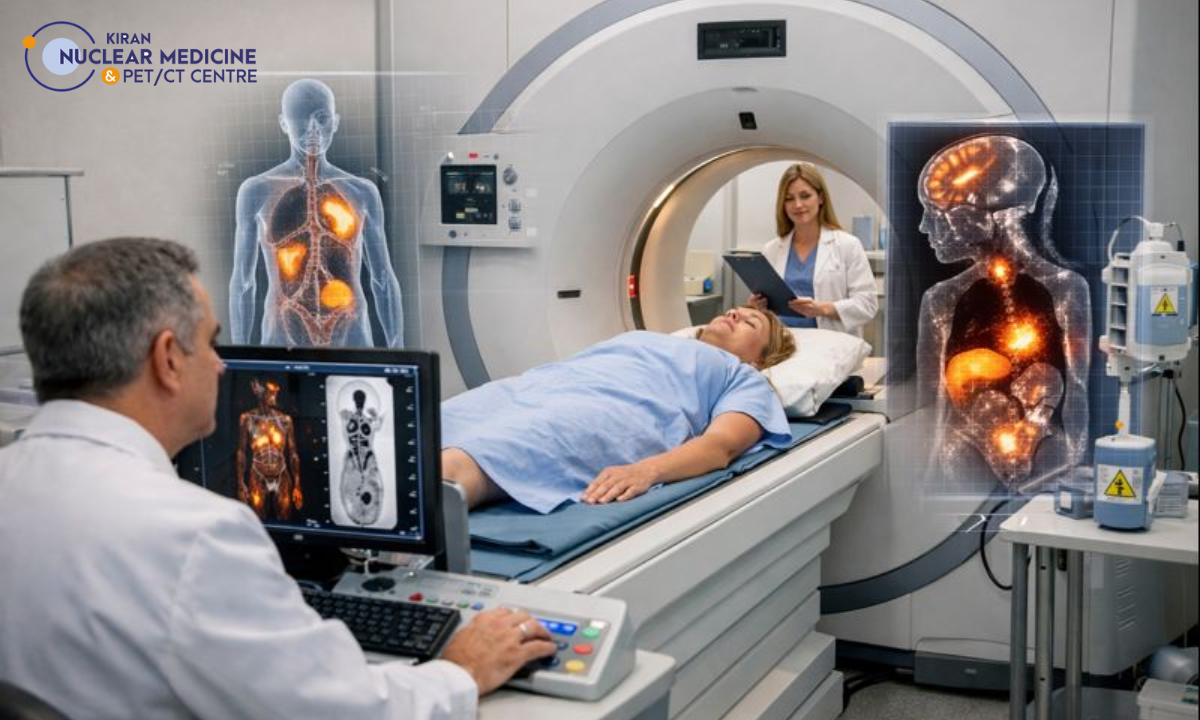
When it comes to a life-changing cancer diagnosis, accuracy is the only thing which matters. While most patients are familiar with the standard FDG scan, certain rare, slow-growing tumors require a much more sophisticated approach.
If you are searching for a high-precision DOTANOC PET scan in Bangalore, you are likely dealing with a condition that demands molecular-level fine clarity. At Kiran PET CT, the leading PET Scan centre in Bangalore, we specialize in this advanced imaging to ensure no hidden lesions go undetected.
Choosing the right PET scan in Bangalore is the critical first step in moving from medical uncertainty to a decisive, life-saving treatment plan. Standard scans often rely on sugar mapping to find cancer, but many tumors, particularly Neuroendocrine Tumors (NETs), do not follow this pattern.
They grow quietly and can remain invisible on traditional imaging for years.
A DOTANOC scan changes the game by targeting specific receptors on the tumor’s surface rather than its metabolism. This specialized technology allows our specialists to pinpoint the exact location, size, and spread of the disease with a level of detail that was impossible a decade ago.
By bridging the gap between subtle symptoms and a definitive diagnosis, we empower patients with the truth they need to fight back effectively.
DOTA Scan Full Form and Function
Understanding the science behind a DOTANOC scan helps patients realize why it is the superior choice for specific tumors.
The DOTA scan full form refers to Dodecanetetraacetic Acid, which acts as a “chelator” or a biological cage.
This cage holds a radioactive tracer, usually Gallium-68 and is linked to a specific peptide that acts as a key to unlock the secrets of cancer cells.
Unlike standard PET scans that look for high sugar consumption (metabolism), the DOTANOC scan looks for “Somatostatin Receptors” (SSTR) on the surface of cells.
Most Neuroendocrine tumors are covered in these receptors.
When the DOTANOC tracer is injected, it travels through your bloodstream like a homing missile, searching for these specific receptors to latch onto.
The Biological Flowchart: How DOTANOC Pinpoints Rare Tumors
- Step One (Injection): A small, safe amount of the Gallium-68 DOTANOC tracer is injected. This tracer is uniquely designed to ignore normal cells and seek out high concentrations of Somatostatin receptors.
- Step Two (Molecular Binding): The tracer locks onto the receptors found on the surface of the tumor. Because DOTANOC has a broad affinity for multiple receptor subtypes (SSTR2, SSTR3, and SSTR5), it can find tumors that other scans might miss.
- Step Three (Positron Emission): As the radioactive Gallium-68 decays, it emits positrons. The highly sensitive PET scanner at Kiran PET CT detects these signals with extreme precision.
- Step Four (3D Mapping): The scanner converts these signals into a detailed 3D map. This map shows exactly where the cancer is located, even if the tumors are tiny or hidden deep within organs like the pancreas or lungs.
This Lock and Key mechanism is what makes the DOTANOC scan a cornerstone of modern precision oncology.
It shows exactly what is wrong at a molecular level, allowing for a much more accurate cancer diagnosis.
Targeting Neuroendocrine Tumors (NETs)
The biggest challenge in a cancer diagnosis for Neuroendocrine Tumors (NETs) is that they are slow burners.
They don’t always behave like aggressive lung or breast cancers. Because they grow slowly, they don’t consume much glucose (sugar).
If you use a standard FDG PET scan, which maps sugar, these tumors often look like healthy tissue, leading to a false negative report.
This is where DOTANOC becomes an indispensable tool.
It ignores sugar entirely and focuses on the protein receptors that are unique to these tumors.
Whether it is a small growth in the gastrointestinal tract or pancreatic cancer that is neuroendocrine in nature, DOTANOC provides the clarity that standard imaging lacks.
Table: FDG PET Scan vs. DOTANOC PET Scan
| Feature | Standard FDG PET Scan | DOTANOC PET Scan |
|---|---|---|
| Primary Target | Glucose (Sugar) Metabolism. | Somatostatin Receptors (SSTR). |
| Best Used For | Aggressive, fast-growing cancers like Lung, Lymphoma, and Breast cancer. | Slow-growing Neuroendocrine tumors (NETs) and certain rare cancers. |
| Effectiveness for NETs | Often fails to detect low-grade, slow-growing tumors. | The Gold Standard for identifying both primary and metastatic NETs. |
| Clinical Goal | Measures how “hungry” or active a tumor is. | Maps the specific “identity” and receptor density of the tumor cells. |
By utilizing this specialized scan, specialists at Kiran PET CT can differentiate between a standard tumor and a neuroendocrine one.
This distinction is vital because the treatment for these two types of cancer is completely different.
A mistake in identification at this stage can lead to months of ineffective treatment.
Impact on Treatment Planning
A successful cancer diagnosis is only the first step.
The real value of a DOTANOC scan lies in its ability to dictate the entire medical roadmap. In modern oncology, this is known as treatment planning.
Before a surgeon decides to operate or an oncologist chooses a specific drug, they need to know if the cancer is localized to one organ or if it has spread to distant lymph nodes.
The DOTANOC scan provides a receptor map of the patient’s body.
If the scan shows that the tumors have a high density of Somatostatin receptors, it opens the door to a highly advanced form of therapy called PRRT (Peptide Receptor Radionuclide Therapy).
Without this specific scan, a patient might be subjected to heavy chemotherapy that is completely ineffective for their specific tumor type.
The Clinical Roadmap: How DOTANOC Changes the Treatment Strategy
- The Surgical Decision: If the scan identifies only a single, isolated tumor in the pancreas or bowel, the surgeon can proceed with a curative operation.
If the scan reveals tiny micro-metastases in the liver that were invisible on a CT scan, surgery may be avoided in favor of systemic therapy.
- PRRT Eligibility: This is the most critical role of the scan. Only patients whose tumors “light up” brightly on a DOTANOC scan are candidates for Lutetium-177 Dotatate therapy.
The scan acts as a test run to see if the treatment will actually reach the cancer cells.
- Monitoring Recurrence: After treatment is completed, many patients live in fear of the cancer returning.
Periodic DOTANOC scans can detect a recurrence months before symptoms appear or before a standard blood test shows any abnormality.
By providing this level of detail, Kiran PET CT ensures that every patient receives a personalized treatment plan.
We move away from one-size-fits-all” medicine and toward a precision-based approach that saves time and improves survival rates.
Pancreatic Cancer and Rare Tumors
While DOTANOC is the gold standard for neuroendocrine tumors, its clinical utility extends far beyond just one type of growth.
It is an essential diagnostic tool for identifying hidden lesions in the pancreas and other rare, hormone-producing tumors. In many cases of pancreatic cancer, standard imaging like a CT scan or a regular FDG PET scan might show a mass, but it cannot always distinguish between a standard adenocarcinoma and a pancreatic neuroendocrine tumor (pNET).
This distinction is life-changing.
A standard pancreatic cancer often requires aggressive chemotherapy, whereas a neuroendocrine tumor in the pancreas might be managed with targeted biological therapies or a specialized surgery.
Using a DOTANOC scan ensures that the cancer diagnosis is precise from the very beginning, preventing the patient from undergoing unnecessary or incorrect treatments.
Clinical Checklist: When is a DOTANOC Scan Recommended?
- Unexplained Hormonal Symptoms: Patients experiencing “Carcinoid Syndrome” (sudden flushing of the face, chronic diarrhea, or unexplained wheezing) even when standard blood tests are normal.
- Pancreatic Mass Evaluation: When an initial scan shows a growth in the pancreas and the doctor needs to confirm if it is a neuroendocrine tumor.
- Pheochromocytoma and Paraganglioma: Rare tumors of the adrenal glands or nerve cells that produce massive amounts of adrenaline, causing life-threatening blood pressure spikes.
- Occult Primary Search: When a biopsy of the liver shows neuroendocrine cancer cells, but the original (primary) tumor location is hidden deep in the bowel or lungs.
- Cancer Diagnosis Prostate Comparison: While prostate cancer usually requires a PSMA scan, certain rare “neuroendocrine differentiated” prostate cancers may actually require a DOTANOC scan to map the disease accurately.
By identifying these rare tumors at their earliest, most treatable stage, we provide patients with a much higher chance of long-term survival.
At Kiran PET CT, we understand that these rare conditions require a specialized eye and the most advanced imaging technology available in India.
Why Choose Kiran PET CT?
For a patient or family dealing with a complex cancer diagnosis, the quality of the technology and the expertise of the medical team are the only factors that truly matter.
At Kiran PET CT, the premier PET Scan centre in Bangalore, we have invested in the GE-Discovery IQ Gen 2.
This is one of the most advanced imaging platforms in the world, specifically designed to detect tiny, millimetric lesions that older machines might miss.
For a DOTANOC PET scan in Bangalore, this level of sensitivity is non-negotiable because neuroendocrine tumors often hide in the dense tissues of the bowel or the pancreas.
Our facility is led by a team of highly specialized nuclear medicine physicians, including Dr. Kiran Kumar JK and Dr. Manoj Devanathan.
They bring decades of clinical experience from India’s top medical institutions like PGIMER and JIPMER. When you choose our center for a PET scan in Bangalore, you are not just getting a medical report.
You are getting a precise, molecular-level analysis that your oncologist can use to build a successful treatment strategy.
Table: The Kiran PET CT Clinical Advantage
| Standard Diagnostic Center | Kiran PET CT Specialist Center | The Patient Outcome |
|---|---|---|
| Older Generation Scanners: Lower resolution images may miss tiny “micro-metastases” in the liver or bone. | GE-Discovery IQ Gen 2: High-definition 3D mapping that identifies even the smallest traces of active cancer. | You receive a more accurate staging of the disease, preventing under-treatment or unnecessary surgeries. |
| Standard FDG Focus: Primarily equipped for common cancers, often lacking specialized tracers for rare tumors. | Full Molecular Menu: We offer specialised DOTANOC, PSMA, and FAPI PET scans for rare and aggressive cancers. | You get the specific scan required for your exact tumor type, ensuring a definitive and clear diagnosis. |
| Delayed Reporting: Reports often take two to three days, causing immense anxiety and delaying treatment. | Same-Day Reporting: Our streamlined clinical workflow provides you with accurate results within hours of your scan. | Your medical team can start your life-saving treatment plan almost immediately, saving precious time. |
By combining globally acclaimed technology with a compassionate, patient-first approach, Kiran PET CT stands as the most trusted destination for advanced oncology imaging in Karnataka.
Conclusion
A DOTANOC PET scan is much more than just a medical test.
It is a vital tool that bridges the gap between a vague suspicion and a definitive cancer diagnosis.
For patients with neuroendocrine tumors or complex cases of pancreatic cancer, this scan provides the structural and molecular truth that standard imaging simply cannot reach.
Accurate staging at the very beginning of your journey is the most important factor in determining your long-term survival and quality of life.
Stop settling for generic imaging that may miss the subtle signatures of your condition. If your doctor has recommended a specialized PET scan, choose a facility that specializes in high-precision nuclear medicine.
Visit Kiran PET CT in Banashankari or Indira Nagar to experience the gold standard in diagnostic care. Book your appointment today and let our expert team provide the clarity, accuracy, and detailed treatment planning you need to fight cancer with absolute confidence.
Sources:
- Primary Source: Kiran PET CT Official Website : https://kiranpetct.com/
- National Center for Biotechnology Information (NCBI): Comparison of 68Ga-DOTANOC PET/CT and 18F-FDG PET/CT in NETs
- Journal of Nuclear Medicine: DOTANOC and Treatment Planning for PRRT
- Mayo Clinic / American Cancer Society: Understanding Pancreatic Neuroendocrine Tumors (pNETs)