
If your oncologist has mentioned Lutetium-177 DOTATATE therapy, one of your first questions will be whether you qualify. Lutetium-177 DOTATATE therapy eligibility depends on far more than a diagnosis of a neuroendocrine tumour (NET). Doctors look at the tumour itself, how it appears on a specialised PET-CT scan, how well your kidneys and bone marrow are working, and which treatments you have already had.
Lu-177 DOTATATE is a form of peptide receptor radionuclide therapy (PRRT) and part of theranostics, in which the receptor a scan detects is then used to deliver treatment. This guide explains each eligibility check, what happens if you qualify and the options if you do not.
Why Does Your Tumour Type Matter?
Lu-177 DOTATATE is approved mainly for somatostatin receptor-positive gastroenteropancreatic NETs, which start in the stomach, intestines or pancreas. Tumours elsewhere, such as in the lungs, may be considered case by case.
Your specialist will review your biopsy report for:
- Primary site: where the tumour started
- Grade and Ki-67 index: how quickly the cells are dividing. The strongest evidence is for well-differentiated grade 1 and grade 2 tumours; faster-growing tumours need careful individual assessment
- Stage: whether the disease has spread, most often to the liver
- Behaviour over time: whether the tumour has grown despite other treatment
Poorly differentiated neuroendocrine carcinomas usually respond better to other treatments. Our article on how Lutetium therapy helps treat neuroendocrine tumours covers the conditions it is used for.
How Do Doctors Read Your DOTATATE PET-CT Scan?

A Ga-68 DOTATATE or DOTANOC PET-CT shows whether your tumours carry enough somatostatin receptors for Lu-177 DOTATATE to attach to. Without that uptake, the treatment has nothing to target.
Comparing tumour uptake with the liver
Many specialists grade uptake against normal liver tissue on a visual scale adapted from the Krenning score. Tumours that take up the tracer at least as strongly as the liver, and ideally more strongly, are generally the most likely to benefit. However, no single score automatically qualifies every patient, and the threshold used varies between treatment protocols.
Checking that every tumour site takes up the tracer
Each significant tumour site should show uptake. If some lesions appear on CT or MRI but do not take up the tracer, those areas may not respond to treatment.
When an FDG PET-CT is added
Some patients also have an FDG PET-CT, which highlights faster-growing cells. Tumours that are bright on FDG but dim on DOTATATE may be more aggressive and less likely to respond to PRRT, which can change the treatment plan.
Our article on the role of DOTANOC PET-CT in treatment planning explains how the scan itself is performed.
What Blood Tests Are Needed Before PRRT?
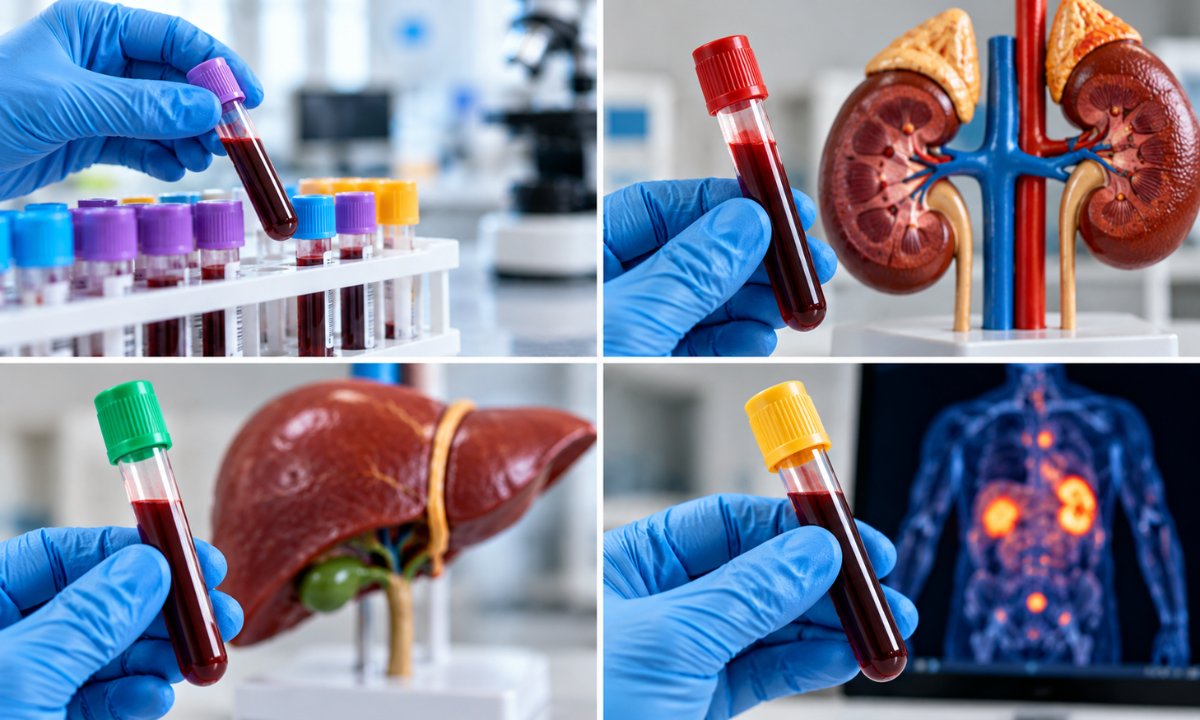
Blood tests show whether your body can safely handle treatment and give a baseline for monitoring between cycles.
| Test | What it checks | Why it matters |
|---|---|---|
| Complete blood count | Red cells, white cells and platelets | PRRT can temporarily lower blood counts, so they need to be adequate at the start |
| Kidney function (creatinine, eGFR) | How well the kidneys filter blood | The kidneys clear the medicine from the body and receive some radiation |
| Liver function tests | Liver health and how far disease has affected it | Extensive liver disease affects safety and planning |
| Tumour markers, such as chromogranin A | Tumour activity | A baseline for judging response, where useful |
During treatment, an amino acid infusion helps protect the kidneys, but it does not replace careful testing beforehand. If your kidney function or blood counts are low, your team may delay treatment, adjust the plan or recommend a different option. Bring all recent reports, and mention any kidney problems, blood disorders or previous radiotherapy.
These tests are usually repeated before and between cycles, so your team can spot any drop in blood counts or kidney function early and adjust the plan. If you have recent results from another hospital, share them, as this can save time and avoid repeat tests.
How Do Previous Treatments Affect Eligibility?
Your treatment history shows how the tumour has behaved and what is most likely to help next. The team will review any surgery, somatostatin analogue injections (octreotide or lanreotide), targeted medicines, chemotherapy and liver-directed procedures you have had.
In many cases, PRRT is considered when a tumour has grown despite somatostatin analogue injections. Earlier treatment also matters for safety. Previous chemotherapy or radiotherapy can reduce bone marrow reserve, and long-acting injections need to be timed carefully around each infusion. Never stop or change a medicine yourself; your team will plan the timing with you.
Liver-directed procedures, such as embolisation, and previous surgery also shape the plan. If most of the disease sits in the liver, your team may weigh PRRT against liver-directed treatment, or use the two one after the other. How you responded to earlier treatment, and any side effects you had, also helps the team judge how well you may tolerate PRRT.
What Other Factors Do Doctors Check?
Eligibility also depends on your overall health and circumstances:
- General health: whether you are well enough to tolerate treatment and attend regular reviews
- Pregnancy and breastfeeding: treatment is not given during pregnancy, and breastfeeding must stop beforehand. Discuss family planning with your team
- Other medical conditions: heart, kidney or bone marrow problems may need extra assessment
- Home circumstances: you will follow radiation precautions for a short time after each cycle, especially around children and pregnant women
- Your goals: the aim may be to control the disease, slow its progress or ease symptoms
When Can Treatment Start If You Are Eligible?
Once your specialist confirms that PRRT is suitable, they explain the schedule, preparation and monitoring plan. Treatment is given as a series of intravenous infusions, commonly four cycles spaced several weeks to a few months apart, depending on your treatment plan and how your blood counts and kidney function recover.
Your team will also tell you whether your somatostatin analogue injections need to be paused or re-timed around each cycle. Our guide to what to expect during Lutetium-177 therapy walks through treatment day, side effects and follow-up in detail.
What If You Are Not Eligible for PRRT?

Being told you are not suitable for PRRT does not mean you have no options. Depending on your tumour, your team may consider:
- Continuing or adjusting somatostatin analogue injections
- Targeted medicines, such as everolimus or, for pancreatic NETs, sunitinib
- Chemotherapy, particularly for faster-growing tumours
- Liver-directed treatments, such as embolisation, for disease mainly in the liver
- Surgery, where the tumour can be removed
Ask whether you could be reassessed later. Receptor status and the behaviour of the disease can change over time.
Some patients may also be offered a clinical trial or a second opinion from another specialist centre. If you are unsure about the decision, ask your team which eligibility check was not met and whether anything could change it, such as improved kidney function or a repeat scan.
Questions to Ask Your Specialist About PRRT Eligibility
Take these questions to your consultation:
- Is my tumour type and grade suitable for PRRT?
- How strong is the uptake on my DOTATATE or DOTANOC PET-CT, compared with the liver?
- Do all my tumour sites show uptake?
- Are my kidney function and blood counts adequate?
- How do my previous treatments affect the decision?
- What are my other options if PRRT is not suitable?
- How will we judge whether the treatment is working?
Bring your biopsy report, previous scans, blood results, medicine list and treatment records. If you have not yet had receptor imaging, ask about a DOTANOC PET-CT scan.
Where to Get a PRRT Eligibility Assessment in Bangalore
An eligibility assessment needs a centre that can perform somatostatin receptor PET-CT, review the results alongside your oncology reports and deliver treatment under Atomic Energy Regulatory Board (AERB) radiation-safety rules. Having imaging and therapy in one place also makes it easier to compare scans before and after treatment.
At Kiran Nuclear Medicine and PET CT Centre, you can learn more about Lutetium-177 DOTATATE therapy at Kiran PET CT, including how receptor-based PET-CT is used to plan treatment. Our team can review your reports and explain the next steps.
Conclusion: Understanding Your Eligibility
Lutetium-177 DOTATATE therapy eligibility rests on several checks working together: the tumour’s type and grade, how strongly it shows up on receptor PET-CT, your kidney function and blood counts, and the treatments you have already had. A positive scan alone does not guarantee suitability, and a “no” today is not always final.
Discuss your reports with your oncologist and a nuclear medicine specialist, and ask them to explain each factor in your case. For a detailed clinical overview, see the NCBI Bookshelf summary of Lutetium-177 DOTATATE therapy.
Book a consultation with Kiran PET CT’s nuclear medicine team to review your eligibility.
Frequently Asked Questions
What is a Krenning score?
A visual scale that compares how strongly tumours take up the tracer on a somatostatin receptor scan with normal tissue such as the liver. Higher uptake usually means a better chance of benefiting from PRRT. The exact score required varies by protocol, so your specialist will explain how it applies to you.
What if only some of my tumours show uptake on the PET-CT?
Your team will assess whether enough of the active disease is receptor-positive. Areas without uptake may not respond, so another treatment or a combined approach may be more appropriate.
Does a high Ki-67 index rule out PRRT?
Not always. The strongest evidence is for grade 1 and 2 tumours, but selected faster-growing tumours may still be considered after specialist review.
Do I need to stop octreotide or lanreotide injections before treatment?
It depends on your treatment protocol. These injections may need to be paused or timed around each cycle, so never stop or change them on your own; your team will confirm what to do.
Does being eligible mean the treatment will cure the tumour?
No. Eligibility means PRRT may be an appropriate option for you. The goal is often to control the disease, slow its growth or improve symptoms, and responses vary between patients.
How long does an eligibility assessment take?
It depends on the tests you already have. If you bring a recent receptor PET-CT, pathology report and blood results, the team can often review them quickly. If a new scan or further tests are needed, allow extra time for these to be arranged and reported.
Can I have PRRT if I have had radiotherapy before?
Possibly. Previous radiotherapy, especially to the abdomen or a large area of bone, can affect your kidneys or bone marrow reserve. Your team will review the dose and the area treated before deciding.